
Skin allergies, also called contact dermatitis, are generally a type IV hypersensitivity. Contact dermatitis may take up to two weeks to appear depending on what has entered the body. The substances that cause contact dermatitis are called haptens (examples are fragrance, dyes, nickel, and the molecules found in poison ivy).
An example of a skin allergy response is when you touch poison ivy. Haptens in poison ivy penetrate the inner layer of the skin, called the dermis. The hapten then gets engulfed by a dendritic cell. The dendritic cell breaks down this molecule, travels to lymph nodes inside the body, and shows parts of the hapten to the immune cells found there. A T cell binds to the dendritic cell to begin a strong immune response against the hapten. The T cell matures into an effector helper T 1 cell (Th1 cell). Next, the Th1 cell releases factors that help produce more Th1 cells. These activated cells go to the site of the poison ivy contact on the skin and encourage inflammation (like swelling, blisters, itching, redness). They also recruit other immune cells to amplify the immune response over the course of 10-14 days.
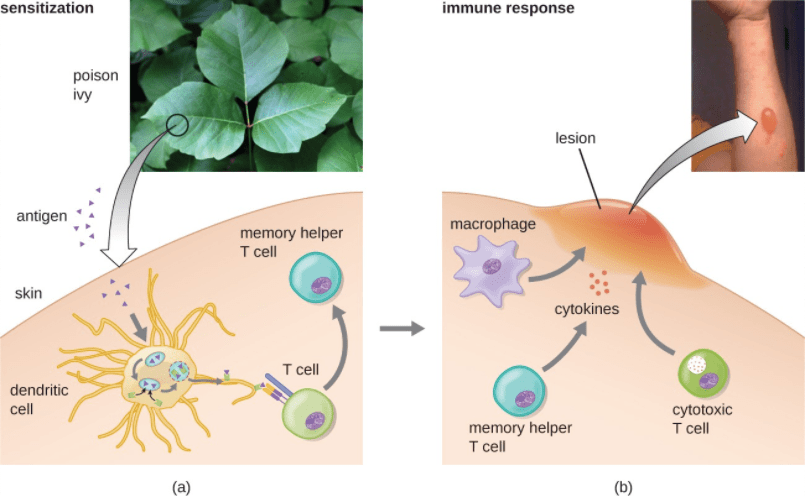
These T cells can then develop into memory T-cells so that the body can recognize poison ivy quicker with the subsequent exposure. For example, the next time you touch this plant, your body has a memory of poison ivy and it is much quicker to react regardless of whether it’s been a week or a year since your last reaction.
Definitions
Antibodies: A blood protein that counteracts a specific antigen. Antibodies combine chemically with substances that the body recognizes as foreign.
Antigen: Any substance that causes your immune system to produce antibodies against it
Contact dermatitis: A skin rash caused by contact with a certain substance
Dendritic cells (DCs): Antigen-presenting cells (APC) in the immune system. Their main function is to process the antigen and present part of it on the cell surface to show the T cells of the immune system. They act as messengers between the innate and the adaptive immune systems
Hapten: A molecule that is incapable, alone, of causing the production of antibodies but can do so when bound to a larger antigenic molecule called a carrier.
Helper T cells: A type of white blood cell and a type of lymphocyte that stimulates killer T cells, macrophages, and B cells to make immune responses. Also called CD4+T lymphocyte (refer to article two for more in-depth on the difference between TH1 and TH2).
Lymph node: Lymph nodes filter substances that travel through the lymphatic fluid, and they contain lymphocytes (white blood cells) that help the body fight infection and disease
Macrophages: Large, specialized cells that recognize, engulf, and destroy target cells
Protein: Must be composed of one or more long chains of amino acids and are an essential part of all living organisms, especially as structural components of body tissues, enzymes, and antibodies
Type IV Hypersensitivity: a cell-mediated reaction that occurs in response to contact with certain allergens resulting in contact dermatitis. Certain allergens must be avoided to treat this condition
 Airway And Skin Allergies